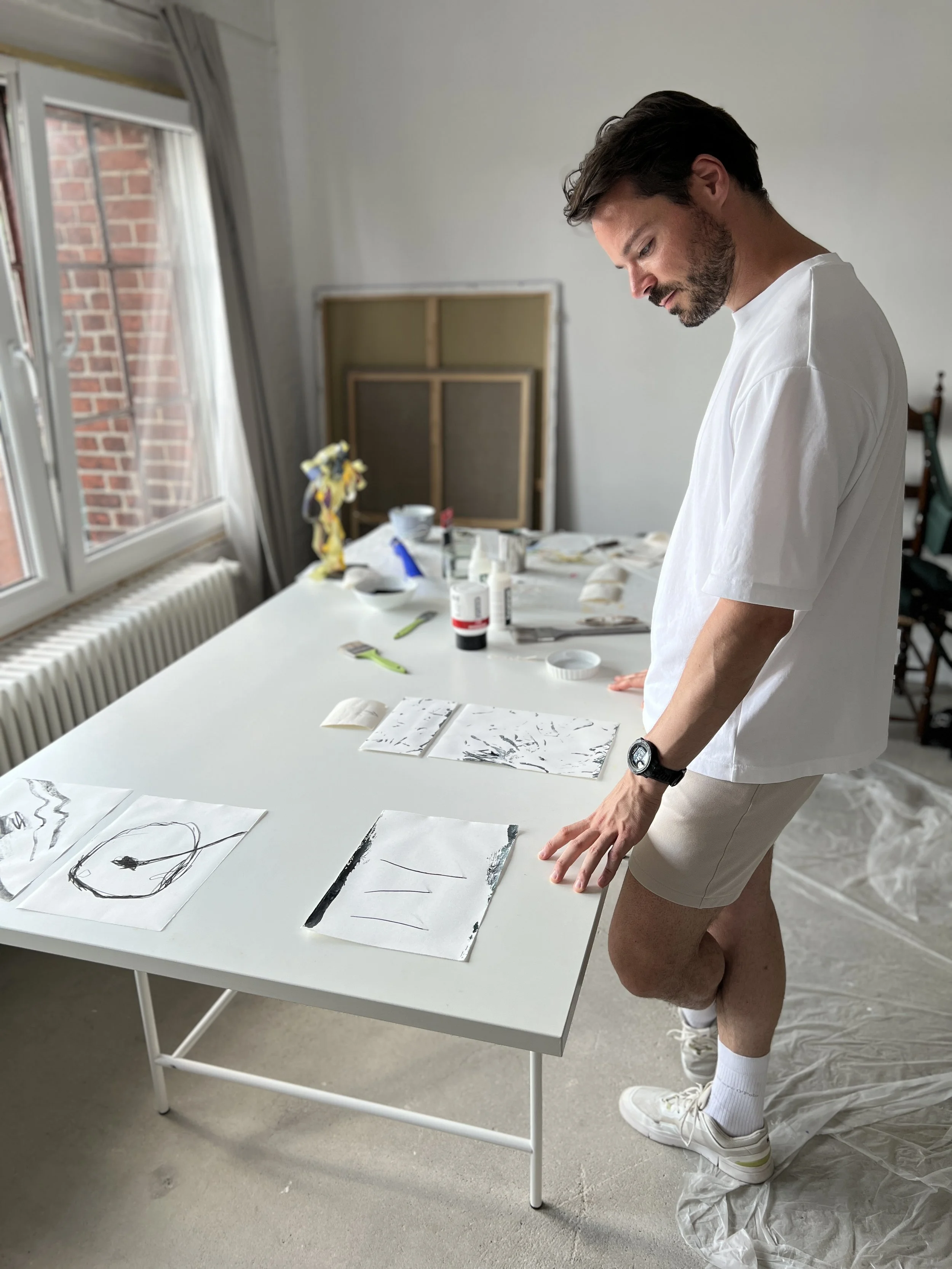
a painter living the life of a violinist.
To play in an orchestra is to understand time as a physical thing - not measured but felt, negotiated, held collectively. Maximilian Simon spent years inside that discipline: reading a score while listening for everyone else, shaping a phrase while remaining accountable to the whole. It is an education in attention that does not leave you when you put the instrument down.
It was the score itself that first drew him toward visual art. Not music as metaphor, but the written page as an object - the particular grammar of notation, the way a printed stave holds duration inside a fixed space, the way dynamic markings and phrase lines accumulate into something that looks, before you have learned to read it, almost like abstract drawing. Simon began to study that visual language with the same seriousness he had brought to performing it. He started to draw it, trace it, depart from it. The mark that a bow makes under pressure - the weight, the angle, the give of horsehair against string - began to reappear in his hand when he held a brush.
When Simon began painting in earnest, he was not looking for an escape from music. He was looking for what music could not hold. A sound disappears the moment it is made; paint stays, accumulates, can be argued with. The canvas offered something the concert platform could not: the chance to remain inside a single moment long enough to understand it.
His paintings are built slowly, in layers - gestural passages worked over with translucent glazes, earlier decisions left visible beneath new ones. The brushstroke carries a memory of the bow: it is not merely applied but drawn across the surface, responsive to resistance, shaped by the speed and pressure of the hand. Materials are chosen for what they do when placed against one another - acrylic, oil, ink, occasionally more resistant substances - and the results are compositions in the musical sense: structures in which each element is heard in relation to all the others.
The titles he gives these works - Saitenwechsel, Mahlers Gedanken, Die Frage nach der Schuld, Schutzmutter - do not describe what is seen. They name the emotional register of the work: friction, weight, the particular quality of a pause before something begins.
He lives and works in Berlin.
painting as resonance
Maximilian Simon understands painting as a field of resonance - a space where rhythm, silence, gesture and colour meet. Rooted in his long-standing practice as a violinist, his visual work emerges from an acute sensitivity to time, tension and atmosphere. His paintings do not depict sound, but seem to carry its traces: a pause, an impulse, a vibration, a moment held just before it disappears.
Working with acrylic, oil, ink, strings, wood and stone, Simon creates compositions in which material and movement respond to one another like voices within a score. Gestural marks meet delicate layers; density opens into silence. Each work invites a slower kind of looking - attentive, intuitive and resonant.
What remains is a sense of aftersound: the quiet impression that colour, gesture and rhythm belong to the same inner field.
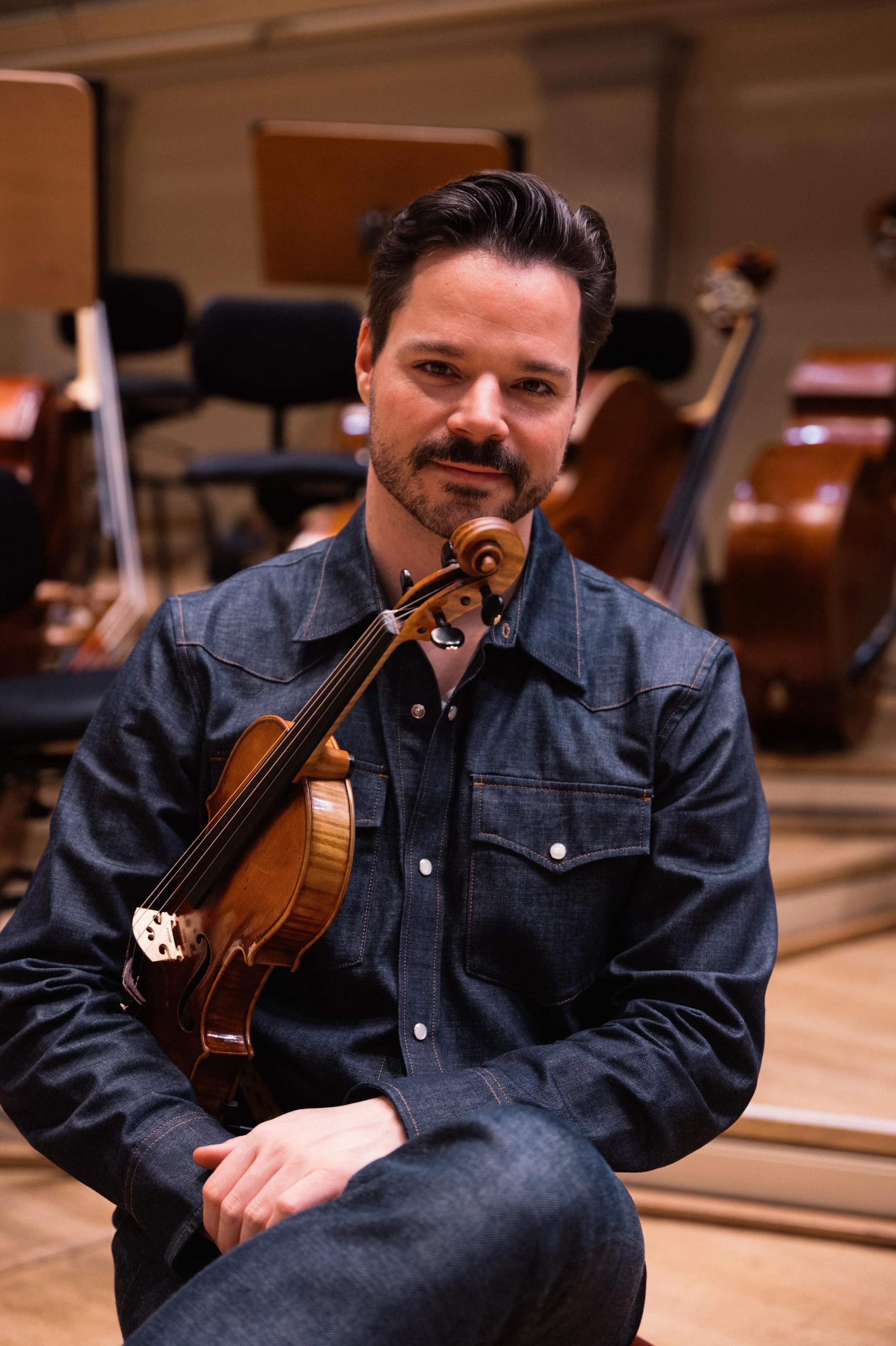
photo by Axel Wegner
beyond the studio
The painting does not exist in isolation from the music. Simon holds the position of Assistant Principal Second Violin at the Rundfunk-Sinfonieorchester Berlin - one of Germany's most distinguished broadcast orchestras - and performs regularly within a repertoire that stretches from the Baroque to the present day. This is not a background detail. It is the other half of the same practice: a professional life spent listening at close range to how structure, emotion and time are held inside the great works of the orchestral canon.
For his work as a violinist - recordings, concert schedule and biography - visit his music website.